Home Office Storage for People Who Still Use Paper
The paperless office has been ten years away for about forty years. Meanwhile, letters still arrive, contracts still need signing, some people still think better with a printout and a pen, and a household’s important documents still live somewhere. If you use paper, the storage question is not how to look as if you don’t. It is how to stop paper from colonising the desk while keeping the right sheet within reach at the right moment.
Most paper problems are sorting problems disguised as space problems. A pile on the desk usually contains four different kinds of document that need four different places: the thing you are working on now, the things waiting for you to act, the things you consult now and then, and the things you keep because you have to. Treat them as one category and you get one pile. Separate them and each can have the right amount of space at the right distance from the chair.
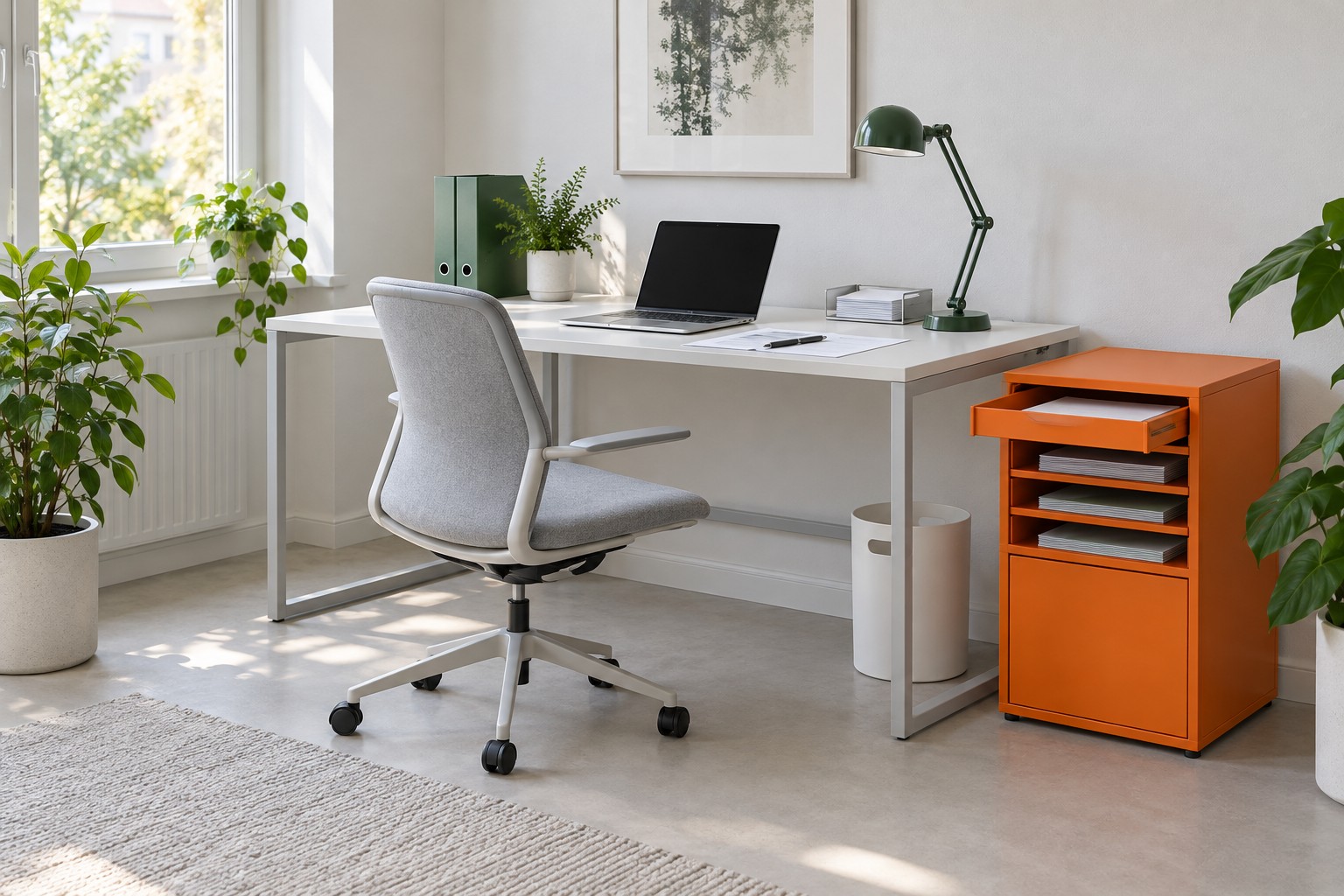
Image credit: pxef.com. AI-generated design concept.
This proposal puts a low orange metal storage unit beside a white desk on a light steel frame, close enough that its top trays are within reach from the seated position. The design assumes a desk of 120 by 70 centimetres, about 47 by 28 inches, and a unit about 45 centimetres wide, 40 deep and 68 high, a little below the desk surface. The upper part holds four shallow open-fronted trays sized for A4 or US letter paper; the bottom is one deep closed drawer, proposed for hanging files; check the internal dimensions and fittings of a real unit. A forest-green desk lamp, a small chrome desk tray and green binders add detail in an otherwise bright, cool-white room. These are assumptions for the concept, and the visible paper is deliberately modest.
Active work is whatever you are using today, and it belongs on the desk or one movement away from it. The top tray of the unit is its address when you step away: the document you are editing, the form half filled in, the printed draft with your notes. Start with one tray for a manageable active workstream, then adjust its capacity if the actual task requires more paper. At the end of the day, today’s paper goes back in that tray. The desk is clear, but your place in the work is preserved.
Waiting-for-action paper is the category that generates most clutter, because it has no obvious home and a deadline that makes you reluctant to file it. Bills to pay, letters to answer, documents waiting for someone else’s signature. Give it the second tray, close to the first, and look at it at a set time, once a day or once a week depending on how much arrives. It helps to keep this tray shallow on purpose. A deep box lets things sink; a shallow tray shows you quickly when it is getting full.
The remaining shallow trays can hold things you reach for during the week: blank paper for notes, envelopes, a current project’s reference sheets. Their value is that they are open and visible. You can slide one out from the chair, take what you need and push it back without standing up.
Reference material is paper you consult but do not act on: insurance documents, manuals, the background file for an ongoing project, records you might need this year. It belongs in the closed drawer, in hanging files with plain, consistent labels. A closed drawer keeps it from becoming visual noise and gives a measure of privacy from anyone glancing at the desk. A drawer the depth of hanging files holds more than people expect, which is also the warning sign. If it fills, that is the moment to move older files out, not to buy a second cabinet.
Archives are the things you keep for years and rarely open. They do not need prime space next to the chair. A box on a high shelf, in a cupboard or in another room is fine, as long as it is labelled and dry. How long particular documents should be kept depends on their type and on where you live, so check official guidance or a professional for tax, legal and financial records rather than relying on a general rule. What this design does is make sure archives never compete with today’s work for space.
Paper also needs a way in. In many homes it arrives by post near the front door, gets carried around and lands wherever there is a flat surface. Decide where incoming paper goes when it reaches the office. In this concept, it lands in the waiting tray, which makes that tray the single place to check. Printed pages need a defined destination too; our printer storage article deals with where the machine and its output live.
It also needs a way out. Each category has a natural exit: active work becomes reference or goes away when finished; waiting paper is acted on and then filed or discarded; reference moves to archive when it ages; archive is cleared when it is no longer needed. Put a recycling bin within reach so that the easy exits happen immediately. For anything carrying personal details, such as account numbers, addresses or identity information, shredding before disposal is the commonly recommended practice. Consumer protection guidance suggests shredding sensitive documents before throwing them away, and community shredding events or other secure services are alternatives if you do not own a shredder.
Privacy at home is a matter of degree. A closed drawer keeps documents out of casual view, which matters in a shared room or a home office that guests pass through. A lockable drawer adds a little more. Neither turns furniture into a safe, and highly sensitive originals may deserve somewhere more secure. For most people, the useful step is simpler: sensitive paper does not sit in the open trays.
The physical design follows from all this. The trays sit beside the chair, not behind it, because you will reach into them dozens of times a day. Their fronts are open so you can see contents at a glance. The closed drawer is lower because it is opened less. The unit is lower than the desk so its top can serve as a landing spot for a book or a pad. Metal suits the job; it is durable, takes strong colour well and can provide rigid shelves when its construction and rated load suit the paper you intend to store. Orange gives the most-used piece of furniture in the room a cheerful identity, and the forest-green details keep it from shouting.
A modest collection is the honest goal. If you find yourself planning a wall of filing cabinets for a home office, look first at what is actually being kept and whether it needs to be kept there. Scanning helps for reference documents you need to consult but not hold, as long as the scans are named and stored where you can find them. The paper that remains should be the paper that earns its place: today’s work, this week’s tasks, this year’s references.
Try the system for a fortnight before buying anything. Use four labelled stacks on a spare surface, put a recycling bin beside the desk and note where paper keeps escaping. Then buy, or rearrange, storage that matches the categories you actually used. The point is a desk where paper can be worked on, not one that is buried by it.