A Home Office Refresh Using the Furniture You Already Own
When a home office stops working, the instinct is to shop. A new desk, matching storage, perhaps a fresh colour scheme to go with it. Sometimes that is the right answer. More often, the furniture is fine and its arrangement is the problem: a desk facing the wrong way, a cabinet in the spot the chair needs, the most useful shelf on the far side of the room. Moving what you already own costs an afternoon and tells you exactly what, if anything, is genuinely missing.
To make that concrete, here is a worked example. It is an invented scenario built to show the method, not a real client’s room or a documented renovation. Imagine a spare room of 3 by 3.3 metres, about 9.8 by 10.8 feet, used as an office by one person who works there four days a week with a laptop, an external monitor and a modest amount of paper. Over several years they have accumulated five pieces: a light-coloured desk of 120 by 60 centimetres, a slim black adjustable chair, a small red metal cabinet on castors, a blue metal open shelf unit and an older plain white bookcase about 180 centimetres tall.
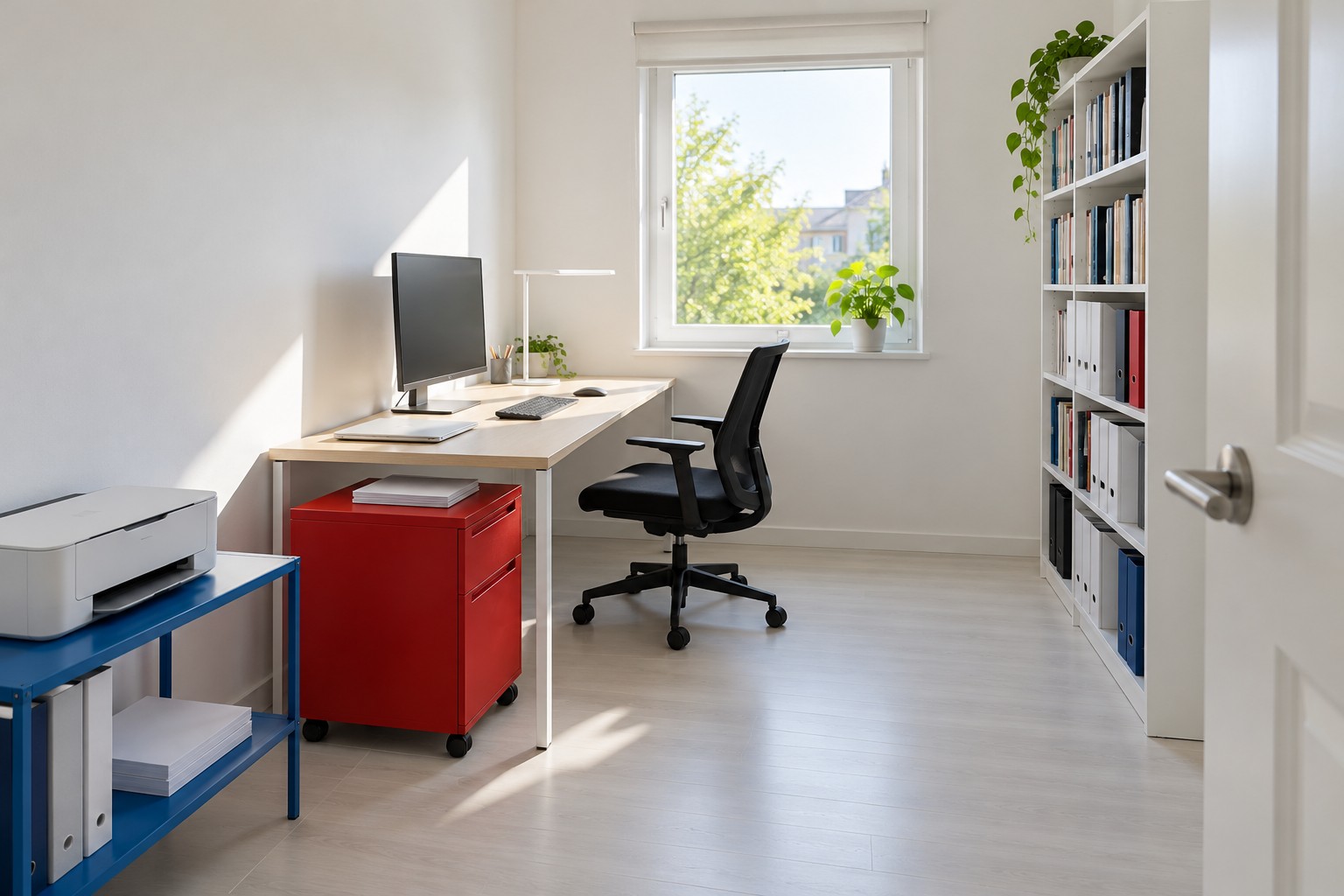
Image credit: pxef.com. AI-generated design concept.
This proposal shows where that same furniture ends up, not a before-and-after. The light desk now stands against the left-hand wall with the window on the worker’s right. The red cabinet tucks beneath the desk’s near end, beside the seated work area and within reach of the chair. The old white bookcase has moved to the wall behind the chair, and the blue shelf stands near the door holding the printer and paper. A single new item, a task lamp, sits on the desk. The palette is limited to what the pieces already bring, white, red, blue and black, against pale walls and a pale floor. Everything else is the arrangement.
The picture keeps the mixture visible: a pale desktop on white legs, the glossy red drawer front tucked at its near end, and a low blue shelf with the printer’s lid free above it. Across the clear floor, the tall white bookcase holds a fairly ordinary collection of binders and books. Nothing needs to look newly bought for the arrangement to have a purpose.
Begin with an inventory, and be specific. Measure each piece, note what it holds and when you use it, and write down its condition. In this scenario, the desk is sound but shallow at 60 centimetres. The chair adjusts properly. The red cabinet has two drawers and a top lower than the desk; check that the papers stored there remain reachable. The blue shelf is low and open. The bookcase is tall, sturdy and full of reference books and binders. That list is the raw material. It also tells you what you cannot change by moving things, such as the desk’s depth.
Next, name the daily conflict, not the general feeling. “The room doesn’t work” is not something you can fix. In this example, three specific things go wrong every day. The desk faces the window, so the monitor sits against bright sky in the afternoon and the worker squints. The chair backs toward the door, so the person working is startled each time someone comes in. And the red cabinet is in the far corner, behind the chair, so the drawers that hold current papers require standing up and turning round every time. There is a fourth, smaller one: the printer lives on the bookcase, at chest height, and the scanner lid hits the shelf above.
Then move things and try them before buying anything. Turn the desk to the side wall so the window falls to one side of the screen rather than behind it. That may reduce the bright background, although the blind and actual reflections still need testing, a relationship our window glare guide explains in more detail. In the new position, the worker also sits side-on to the door rather than with their back to it. Roll the red cabinet beside the desk on the side away from the window, with enough exposed access to its top and drawers for current papers. Keep it out of the leg space. Move the printer from the bookcase to the top of the low blue shelf near the door, where its lid opens freely and anyone in the household can collect a page without crossing behind the chair. The bookcase goes to the wall behind the chair, where reference material is a turn away but not in the working view.
Test each move for a day or two before committing. Sit, work, push back, stand up, open the drawers, print something. In this scenario, the first attempt puts the bookcase on the wall beside the door, where it narrows the entrance and the door handle meets a shelf edge. Moving it along to the far end of the same wall, still behind the chair but well clear of its movement, fixes that. Small adjustments like this are the reason to test with the real furniture rather than a drawing.
Only now ask what is genuinely missing. In the new layout, the desk no longer gets light from the window directly in front, and the ceiling light leaves the keyboard in the worker’s own shadow in the evening. That is a specific gap with a specific answer: a task lamp. It is the one purchase in this scenario. The shallow desk remains a compromise. For this hypothetical kit, sixty centimetres is proposed to hold the monitor and keyboard with little room for paper. Check the actual stand footprint, viewing distance and keyboard position; some setups will not fit. Moving the current papers to the red cabinet beside the desk offsets that. If the work changed and needed more surface, a deeper desk would become the honest next purchase, and the arithmetic in our guide to how much desk space your work needs would decide how deep.
Some changes deserve caution even when they cost nothing. A tall bookcase that was standing unsecured in one corner should not simply be moved to another wall and left unsecured. Follow the furniture maker’s instructions for anchoring, and in a rented home check what wall fixing is allowed first; our rental office guide goes through that. Repainting old furniture can also be tempting as part of a refresh, but finishes, primers and the furniture’s material all matter, and laminate, metal and solid wood behave very differently. It is not automatically a good idea, and it is not needed here. The mixed colours already work together because each piece has one clear colour and none of them fights for the same role.
The mixed set is part of the point. A red cabinet, a blue shelf, a black chair and a white bookcase were not bought as a scheme, but in a bright room with pale walls they read as deliberate accents rather than leftovers. The trick is to give each colour a job. Red marks the active work zone beside the desk. Blue marks the shared equipment by the door. White recedes as background storage. Black stays with the chair. That logic is easier to see after the furniture has been sorted by purpose.
It is worth distinguishing this kind of refresh from a shopping list dressed as sustainability. Buying a new desk made of recycled material to replace a sound desk that was simply in the wrong place is still buying a desk. Here, the improvement comes from position and use: the same five pieces now each serve a particular task, and the only new object answers a problem the rearrangement revealed. That is a modest outcome by the standards of a renovation feature. It is also what most home offices need.
To try this in your own room, empty the floor of anything loose, measure what you have and list the three things that annoy you most each day. Move one piece at a time to address one annoyance, and live with it before moving the next. Keep a note of what you would buy if you could. By the end of the week, that list will usually be shorter than it was on the first day.