A Rental Home Office Without Built In Furniture
Built-in furniture is the obvious answer to a small office until you remember that you will move. A fitted desk along an alcove, shelving screwed into the plaster and a cable run chased into a wall all belong to the flat, not to you. For a renter, the more useful question is how to build a home office that works properly now and comes apart cleanly later, with the room returned to the state the lease expects.
That suggests a different kind of design brief. Everything stands on the floor or clamps to its own furniture. Nothing depends on the wall for support unless you have checked that fixing is permitted. Storage is chosen only after checking its manufacturer’s stability and restraint requirements. Cables plug into existing outlets and stay reachable. And the whole kit can be dismantled, carried down a stairwell and set up in a different room with different windows.
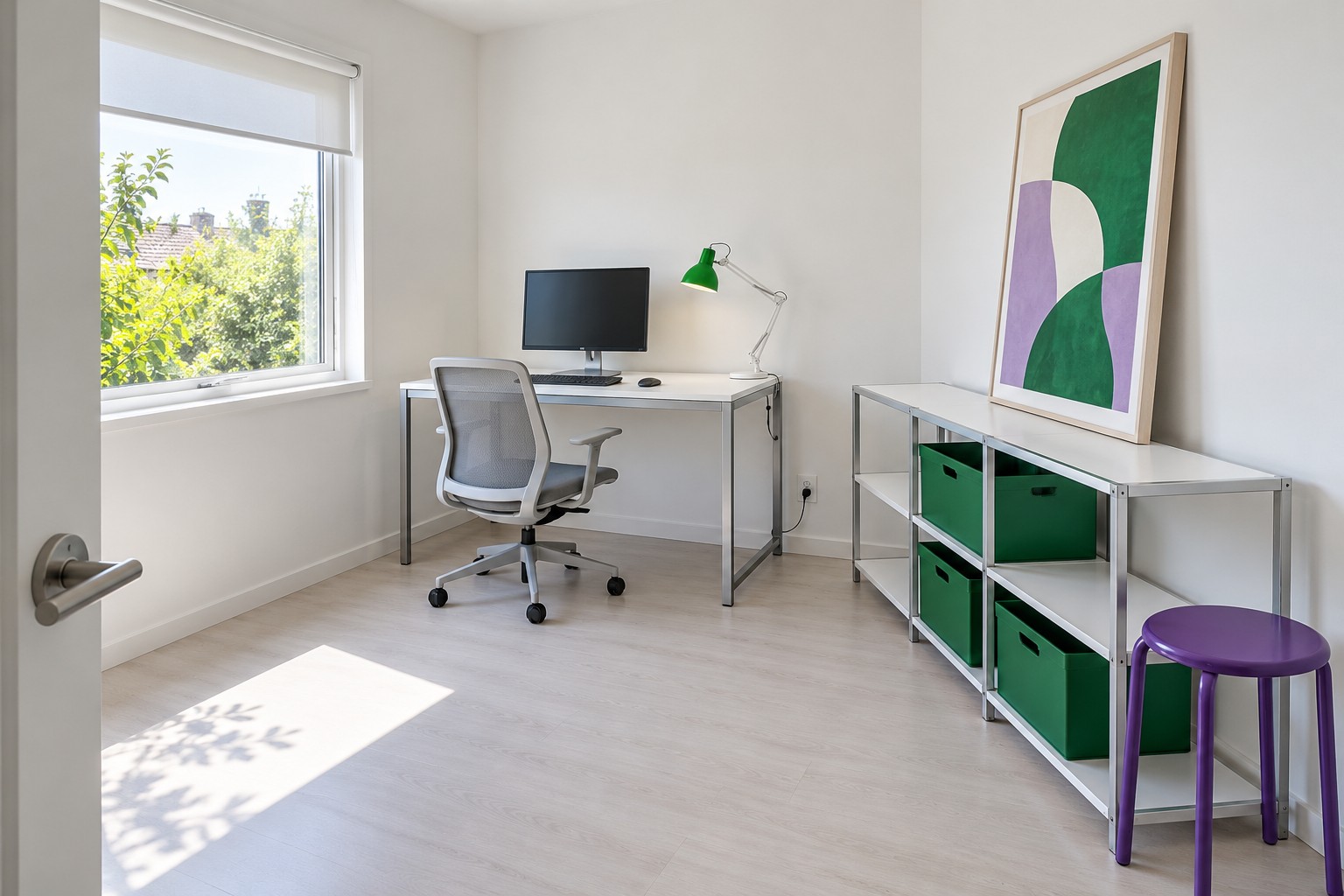
Image credit: pxef.com. AI-generated design concept.
This proposal is a rented room of 3 by 3.5 metres, about 9.8 by 11.5 feet, with white walls, a window on one side and existing sockets near the floor. A freestanding desk of 130 by 70 centimetres, about 51 by 28 inches, stands on an aluminium frame against the wall beside the window. Low modular shelving in aluminium and white runs along the adjacent wall, no higher than the desk, with saturated green bins and boxes. A clamp-on task light grips the back edge of the desk, and one purple element, a stool, provides the second accent. Nothing in the concept is screwed to the wall. Those dimensions and pieces are design assumptions for a typical rented spare room, not a surveyed flat.
Freestanding does not automatically mean safe, and this is the point most rental advice skips. Tall bookcases, shelving units and cabinets can tip over, especially when drawers or doors are open or when someone, often a child, climbs or pulls on them. Furniture makers and safety regulators advise anchoring such units to the wall, and many tall units come with anchoring hardware and instructions that assume it will be used. If the lease prevents that, the safer design move is to choose storage that does not need it. That is why the shelving in this proposal stays low. A long run at desk height, wider than it is tall, gives a lot of storage, doubles as a surface and stands on its own. Whatever you buy, follow its own assembly and fixing instructions, and do not treat a low height as a substitute for anything the manufacturer says is required.
Read the lease before deciding what can be fixed. Some tenancies allow small fixings that you fill and repaint when you leave; some require written permission; some forbid them entirely, or forbid them in particular walls. Ask the landlord or agent and keep the reply. If wall fixing is allowed, a tall bookcase anchored properly may become an option. If it is not, plan around low and wide storage, freestanding furniture whose assembly and restraint instructions you can follow.
The difference between modular furniture and bespoke joinery is worth stating plainly. Joinery is made to fit one room exactly, which is its strength and its problem when you leave. Modular systems, the sort of accessible, flat-pack, reconfigurable shelving that companies like IKEA made familiar, come in standard units that can be rearranged, extended or split up in the next home. The shelving here is one such idea: frames and shelves in standard widths, with boxes that slide in and out. It will not fill an awkward alcove to the millimetre. It will come apart with the same tools that put it together, and it will make sense in a room you have not seen yet.
Measure more than the room before ordering. The desk and shelving have to get into the building as well as into the space. Check the width of the entrance, the turn at the top of the stairs, the lift if there is one and the door to the room itself, particularly for a one-piece desktop. Then measure the room with its real obstacles: the radiator, the skirting, the window handle’s swing, the socket positions and the door. A 130 centimetre desk fits a 3 metre wall comfortably on paper and may not if the radiator sits in the middle of it.
The desk choice is where a rental office can be generous. Because it stands on its own frame, it can be the right depth for the work rather than whatever depth a wall bracket allows. Seventy centimetres leaves room for a monitor on its stand, a keyboard and a notebook. An aluminium frame can be easier to move, but check the assembled weight before planning cleaning or moving day, and a desk with a removable top flat-packs for the next move. Avoid desks that rely on being screwed to a wall for stability unless you have both permission and suitable walls.
Light needs the same reversibility. Ceiling fittings in rentals are often a single central light, and changing them is a job for an electrician, often with the landlord’s permission. Plug-in lighting avoids that entirely. A clamp-on task lamp keeps the desk surface free, but check that the desk edge is within the clamp’s range, that there is clear space under the edge for the clamp, and that the desk and lamp makers permit that mounting method and surface. A veneered top’s suitability depends on its construction, not veneer alone. A floor lamp near the shelving can light the rest of the room. Both plug into existing outlets.
Cables follow the rules of any reachable setup, with the added constraint that you should not attach anything permanent to the walls or floor. Run power from the nearest existing outlet up a desk leg, keep plugs in a tray or basket you can reach, and keep leads out of the walking route and from under rugs. Adhesive cable clips can leave marks on painted walls, so test one somewhere hidden or keep fixings on the furniture. Our guide to cable management you can still reach follows one such route in detail.
Colour can carry a lot of the personality in a room you are not allowed to repaint. White walls in rentals can look sterile, but furniture and objects can bring the colour with them. In this proposal, saturated green bins on aluminium shelving and a single purple stool do that job. They make the room feel deliberately designed, and they leave with you. Removable options for the walls, such as a large print leaning on the shelving instead of hung, add more without a single hole.
Moving day is the final test, and it is worth rehearsing in your head before you buy. The desktop lifts off its frame. The frame folds or comes apart into a few pieces. The shelving disassembles into frames, shelves and boxes, which carry your files and supplies. The clamp lamp unclamps. The room is left with no holes, no adhesive marks and no cable clips. If any piece of the setup needs a tool you do not own, a second person you cannot count on or a vehicle larger than you can hire, reconsider it now.
A rental office does not need to look temporary. With a good desk, low storage that works as a surface, light that is easy to adjust and colour that travels, it can feel considered and complete. If you are still deciding where the desk should sit, our guide to desk placement in a small office goes through the options. The difference in a rental is simply that every decision has to work twice, in this room and in the next one.