A Basement Home Office With Little Daylight
A basement room is often the one space in a house that nobody else wants, which makes it an obvious candidate for an office. It is quiet, separate from the bedrooms and kitchen, and usually big enough for a proper desk. It is also often dim, sometimes damp and occasionally cold, with a high narrow window that offers a view of a lightwell or the bottom of a hedge. Plenty of people try a basement office, find it gloomy and retreat to the kitchen table within a month.
A basement office can work very well, but only if the room is healthy first and then lit and finished as if daylight is a bonus rather than the main source. That order matters. No amount of bright paint will make a damp room comfortable, and a dry room with poor light still feels like a cellar. Deal with the air and moisture, then build the light in layers, then use colour and materials to do the rest.
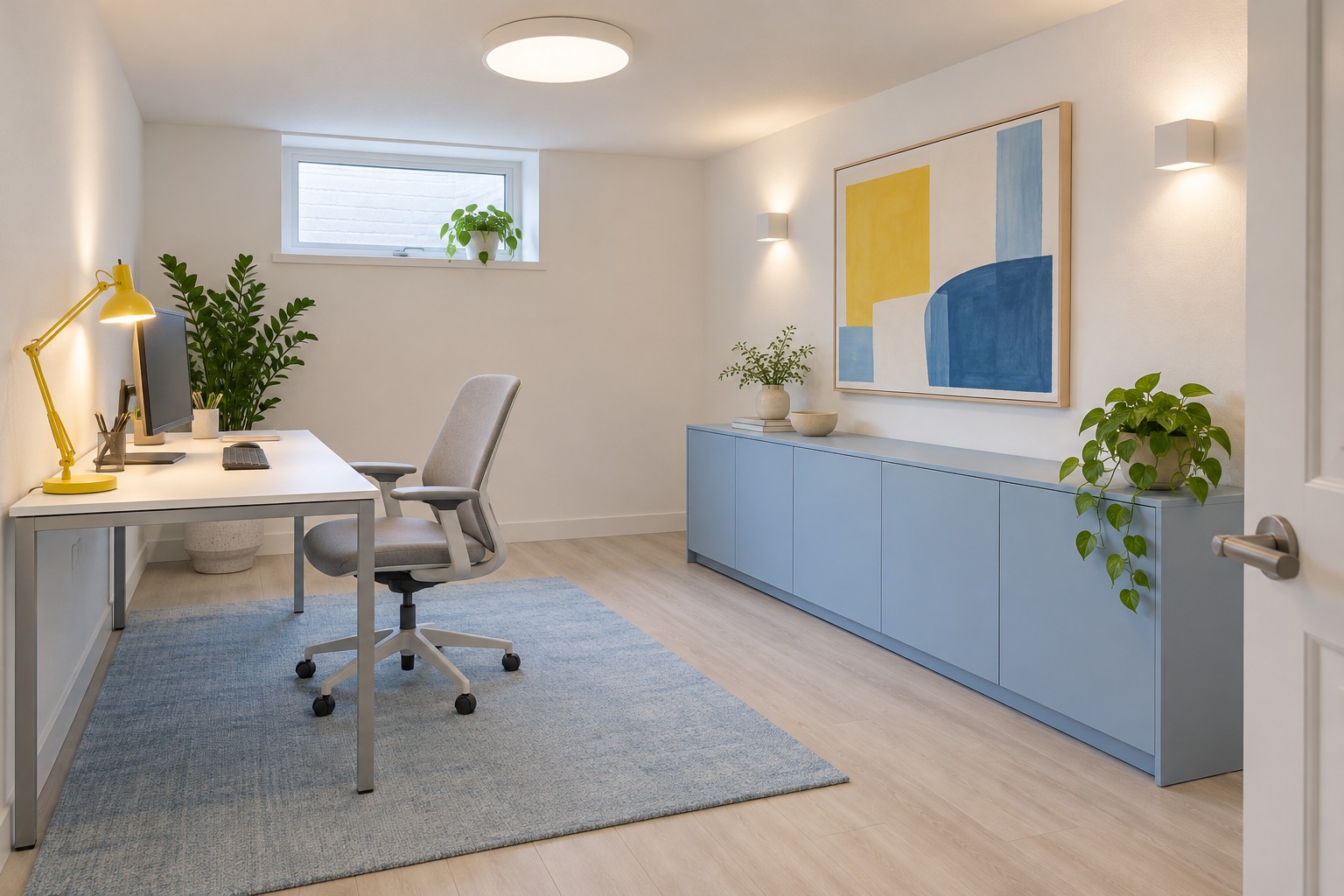
Image credit: pxef.com. AI-generated design concept.
This proposal assumes a basement room of 3.4 by 4 metres, about 11.2 by 13.1 feet, with a ceiling height of 2.3 metres. A single high window, 100 centimetres wide and 45 centimetres tall, sits near the top of the far wall and looks into a lightwell. The desk, 130 by 70 centimetres or roughly 51 by 28 inches, stands against the left-hand wall close to the window wall, so the daylight that does arrive falls across the desk from the right. The walls and ceiling are white, the floor a pale vinyl plank. Sky-blue cabinets line the right-hand wall, and a lemon-yellow task lamp stands on the desk, with a wide ceiling fitting and two wall lights providing the room’s general light. These are assumptions for the concept, not a surveyed basement.
The high window shows pale brick in the lightwell, while the broad ceiling fitting and two wall lights are visibly on. The yellow lamp marks the desk surface on the left. Opposite it, a long blue cabinet and a large blue-and-yellow abstract print carry the colour, with a pale blue rug under the chair. None of those visual signs establishes air quality or damp protection; they illustrate the finishing and lighting proposal.
Check the room’s health before you buy a single lamp. Basements sit against or below the ground, so they are prone to moisture coming through walls and floors and to condensation on cold surfaces. Look for damp patches, tide marks, peeling paint, a musty smell or condensation on the window and pipes. A cheap hygrometer gives a reading for humidity; consumer guidance on mould generally suggests keeping indoor humidity below about 60 percent and ideally between 30 and 50. If there are signs of water coming in, that is a building problem to diagnose and fix before the room is furnished. A dehumidifier can help with ordinary dampness but cannot cure a leak.
Check local radon guidance and test the home before establishing a regularly occupied basement office; location or a room’s appearance cannot establish its level. Radon is a radioactive gas that comes from the ground, and because it enters through floors and walls, levels tend to be highest in the lowest parts of a building, such as basements. Public health agencies recommend testing homes, and test kits are widely available. A basement you plan to spend eight hours a day in is exactly the room to test. If levels are raised, reducing them is specialist work, and the advice of your local health authority is the place to start.
Habitable use of a basement is also subject to local rules about ceiling height, escape and ventilation in many places. Those depend on where you live and whether the room is already used as living space, so check them before turning a storage cellar into a workroom.
With the room dry and checked, put the desk where the daylight is. Daylight from a small high window fades quickly as you move away from it, so the useful zone is close to the window wall. Placing the desk against the side wall, near the window wall, lets that light fall across the desk from the side, which suits a screen better than facing the window directly. Facing a high window can place bright sky behind the display; a window behind your seat can cause reflections. Check both at actual working times and adjust the shading.
Then build the electric light in layers, because it is doing most of the work. A basement office benefits from three. General light comes from the ceiling, ideally a wide fitting or several smaller ones that spread light across the whole ceiling rather than a single bulb in the middle. Wall light washes the walls, which makes the room feel larger and brighter and avoids the cave effect of a lit desk in a dark room. Task light falls on the desk itself, from a lamp you can aim. In this concept, a broad ceiling fitting, two wall lights on the long walls and the yellow desk lamp share those jobs. Keeping them on separate switches lets you adjust the room for screen work, paper work or a call. Any new fixed lighting or circuits are work for a qualified electrician.
Choose light sources by brightness and appearance, not wattage. Lumens describe how much light a source produces; light appearance describes whether it looks warmer or cooler. In a room without much daylight, a neutral to slightly warm appearance tends to feel natural, while very warm amber light can make a basement feel dim even when it is technically bright enough. Try a couple of options and judge them at the desk, at the time of day you work.
Surfaces multiply the light you install. White ceilings and walls reflect much more light than dark ones, and in a low basement room the ceiling is close enough to act as a large reflector for upward light. Matte finishes spread light softly and avoid reflections in the screen. A pale floor helps too. Colour belongs on furniture and objects, where it adds energy without absorbing the light the room depends on. That is why the sky-blue cabinets and lemon lamp do the colour work in this concept, rather than a painted feature wall.
Air and temperature are part of comfort. Basements can be cool, which is pleasant in summer and chilly in winter. A rug under the desk and chair warms the floor underfoot. A dehumidifier removes moisture; it does not supply fresh air or remove radon reliably. Have the room’s ventilation assessed for its intended use. Opening a window may help when outdoor conditions suit, but humid outdoor air can worsen condensation, and an open door is not a substitute for adequate ventilation. Electronic equipment adds a little warmth, which is welcome here, but follow the equipment maker’s ventilation guidance.
The view problem has a partial solution. A lightwell can be brightened with white or light-coloured walls outside the window, which reflect more daylight in. Inside, a plant on the sill and a large print on the wall facing the desk give the eye somewhere to rest. Glancing up from the screen at something bright and colourful is better than glancing at a bare wall in shadow.
There is a compromise to name plainly. A basement office will never feel like a room with a big window. Some people find that easy; others find a full day underground tiring, regardless of how bright the lamps are. Taking breaks upstairs or outside, working near a window elsewhere for part of the day or reserving the basement for focused tasks are all reasonable responses. For evening lighting in general, our guide to office lighting after dark is a useful companion, and for the daytime screen-and-window relationship, see a window without screen glare.
Before committing, spend a full working day in the room with temporary lamps. Note the humidity, how the room feels at four in the afternoon and whether you were glad to go back upstairs. If the room is suitable for occupancy and the lighting works for your tasks, the basement may offer a useful separate workspace.