A Home Office Desk Shared With Homework After School
In many homes, the desk does a second shift. A parent works there until mid-afternoon, then a child arrives home with a backpack and a worksheet and needs somewhere to sit. Sometimes the two overlap: a report due at five, maths homework due tomorrow, one desk. The result is often a daily scramble in which the laptop gets shoved aside, the homework ends up on the kitchen table anyway, and the work papers acquire glitter.
A shared desk works better when it is planned as a desk for two kinds of user rather than an adult’s desk that a child borrows. That means a surface wide enough for two people at once on the days when it matters, seating that fits each user, separate storage so each person’s things have a home, and a simple handover routine. It also means accepting that during school holidays or busy weeks, the arrangement will be stretched.
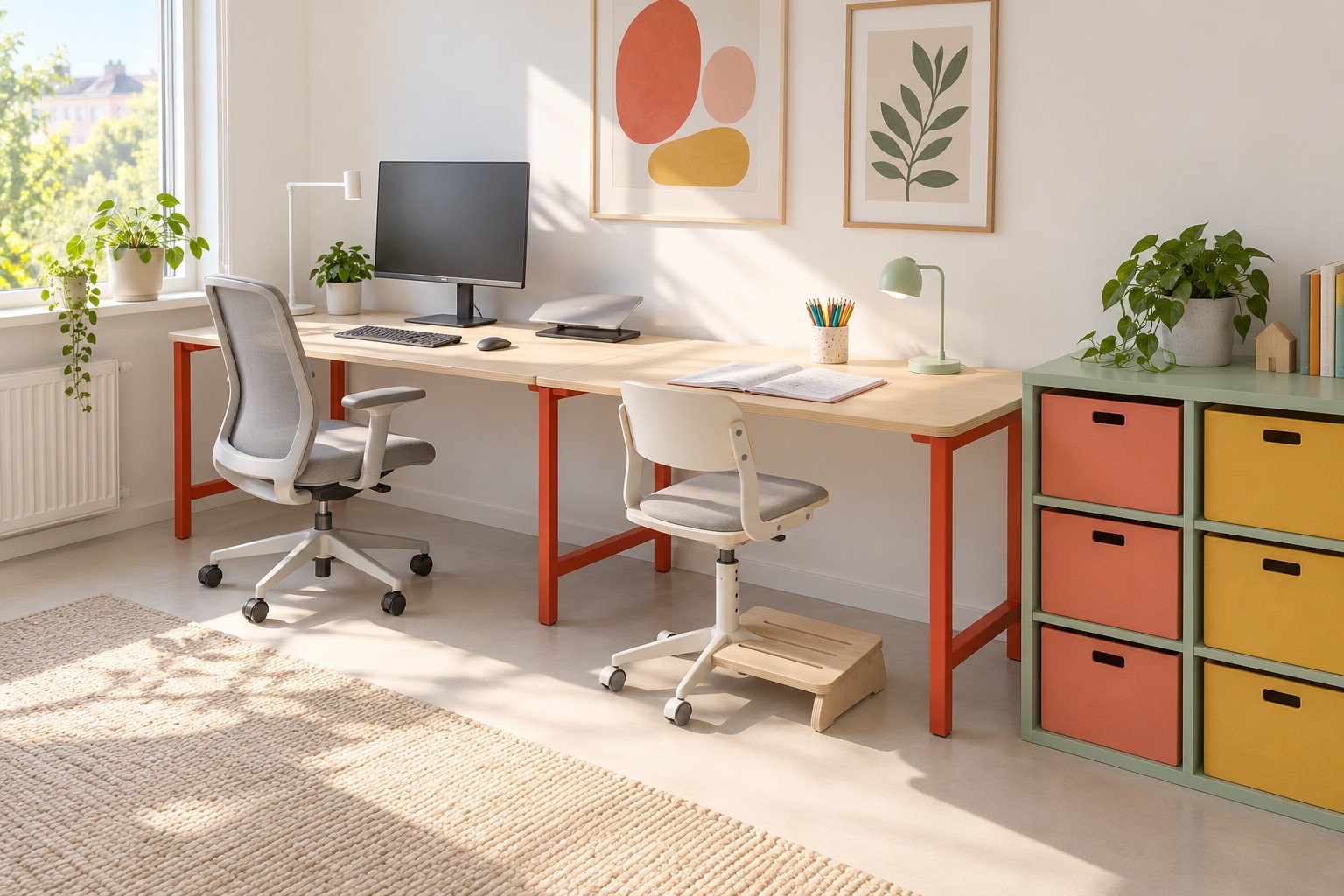
Image credit: pxef.com. AI-generated design concept.
This proposal assumes a desk in the corner of a family room or a spare bedroom of about 3.2 by 3.6 metres, 10.5 by 11.8 feet. The desk is 160 by 70 centimetres, roughly 63 by 28 inches, with two adjoining pale birch top sections on tomato-red steel legs forming one shared desk, against the wall beside a window. The left half is the adult’s: a monitor on a stand, a keyboard, a laptop dock. The right half is the child’s: an open surface, a pencil pot, a small desk lamp. A low mint-green storage unit stands to the right of the desk, divided into two colour-coded halves. An adjustable chair serves the adult, and a second, smaller height-adjustable chair with a footrest sits at the child’s side. These are design assumptions; the right sizes depend on the ages and the work involved.
The red frame supports two adjacent pale worktop sections, making the division visible at the centre. The larger grey chair faces the monitor on the left; the smaller white chair and separate birch footrest face the workbook on the right. Coral and yellow bins occupy different columns of the green storage beside them. It is the separation of supplies and tasks, rather than matching chairs, that makes the shared arrangement legible.
Width is the decision that makes sharing possible. A 120 centimetre desk may accommodate one adult’s kit, but this proposal does not treat it as enough for an adult and a child at the same time, because a child’s homework needs a clear flat area for a book, a workbook and a pencil case, which takes roughly 60 to 70 centimetres of width on its own. At 160 centimetres, the desk can be split into an adult zone of about 90 centimetres and a child’s zone of about 70. On days when only one person is working, either can spread out across the whole surface. If the room cannot take 160 centimetres, plan the child’s homework somewhere else at overlap times rather than squeezing two people onto a desk meant for one.
Height is the difficult part, because adults and children need different working heights from the same surface. A fixed desk is made at one height, usually suited to an adult. A child sitting at it on an ordinary chair will find the surface at chest height, with their arms raised and feet dangling. Two simple adjustments help a lot. An adjustable-height chair, raised for the child, brings their arms closer to a comfortable level. A stable, non-slip footrest sized for the child gives their feet somewhere to rest once the seat is raised. As the child grows, both adjustments change. A height-adjustable desk is another option, but it can only be at one height at a time, so it does not solve simultaneous use.
Give each person their own storage. Shared storage tends to become nobody’s storage. The mint unit in this concept has two halves: the adult’s side holds work papers, a charger and a notebook; the child’s side holds schoolbooks, a pencil case, art supplies and the current homework folder. Each half has a different-coloured box or label so a child can recognise their side without reading. The rule is simple: the end of a session means your things go back on your side. Work papers containing anything confidential should live in the adult’s closed drawer, not in an open shared tray.
Make the screen arrangement deliberate. An adult’s work screen next to a child’s homework space means notifications, meeting windows and emails are visible to a curious reader. For work that involves confidential information, locking the screen when stepping away is useful, but it does not protect visible information during simultaneous use. If the work requires confidentiality, arrange separate working times or a separate location. The reverse applies too. If homework involves a tablet or laptop, give it its own place and charger on the child’s side rather than borrowing the adult’s dock.
The handover is the routine that makes the desk work every day. If the adult usually finishes when the child gets home, five minutes of clearing is enough: the laptop into its drawer, papers on the adult side, the lamp moved or switched. If the two overlap, both sides stay set up and each person works in their zone. Agree on calls. A parent on a video call at the same desk as a child doing spelling practice is uncomfortable for both, and colleagues will hear the spelling. When calls overlap with homework time, the call moves or the homework does. Our guide to two people working in one room deals with these shared-schedule questions in more detail.
Light needs to serve both zones. The window beside the desk gives daylight to both sides in the afternoon. In the evening, each half benefits from its own lamp, so the child can work by their own light without the adult’s lamp shining across the monitor. For handwriting, try the lamp on the side opposite the writing hand to reduce shadows on the page; for a child who writes with their right hand, that means on the left of their zone, and the opposite for a left-handed child. Our article on left-handed tasks looks at that in detail.
Cables and equipment need more caution with children around. Keep power strips and chargers on the adult side, mounted under the desk or out of reach, and keep cables off the floor and out of walkways. Keep the monitor on a stable, properly assembled stand and follow its maker’s placement or restraint guidance. Putting it farther back alone does not prevent tipping. Tall storage units in a home with children should be anchored to the wall according to the manufacturer’s instructions. These are ordinary home-safety points, and they apply with extra force to a desk a child uses every day.
Colour can make the shared arrangement feel fair rather than improvised. Tomato-red legs give the desk a strong, cheerful presence. Mint storage with two colour-coded halves makes ownership visible. Pale birch keeps the surface warm and readable for books and paper. The result should look like a shared desk designed on purpose, not an adult’s office with a child perched at the end.
Before reorganising, watch one ordinary week. Note when each person uses the desk, when they overlap, what each needs on the surface and where things currently end up. Then set out the zones with what you have: a box for each person’s things and suitable, stable seating and foot support. Avoid a loose cushion as a substitute for a chair that fits. If the week runs more smoothly, the plan is worth making permanent with the right furniture.