Home Office Lighting After the Sun Goes Down
The room can change character in minutes when daylight disappears. A desk that worked well all afternoon becomes a bright screen floating in a dark corner, while the notebook beside it grows difficult to read. Turning on the nearest lamp may fix the paper and put a reflection across the display. Evening home office lighting is easier to arrange when you give the screen, the work surface and the rest of the room separate consideration.
Start with the tasks you do after dark. Reading documents, making notes, editing photographs and joining a call are different demands. The light that makes one activity pleasant may be unhelpful for another. You do not need to buy an elaborate collection of fittings to explore those differences. An existing desk lamp and a room light are enough to begin testing where illumination is useful and where it gets in the way.
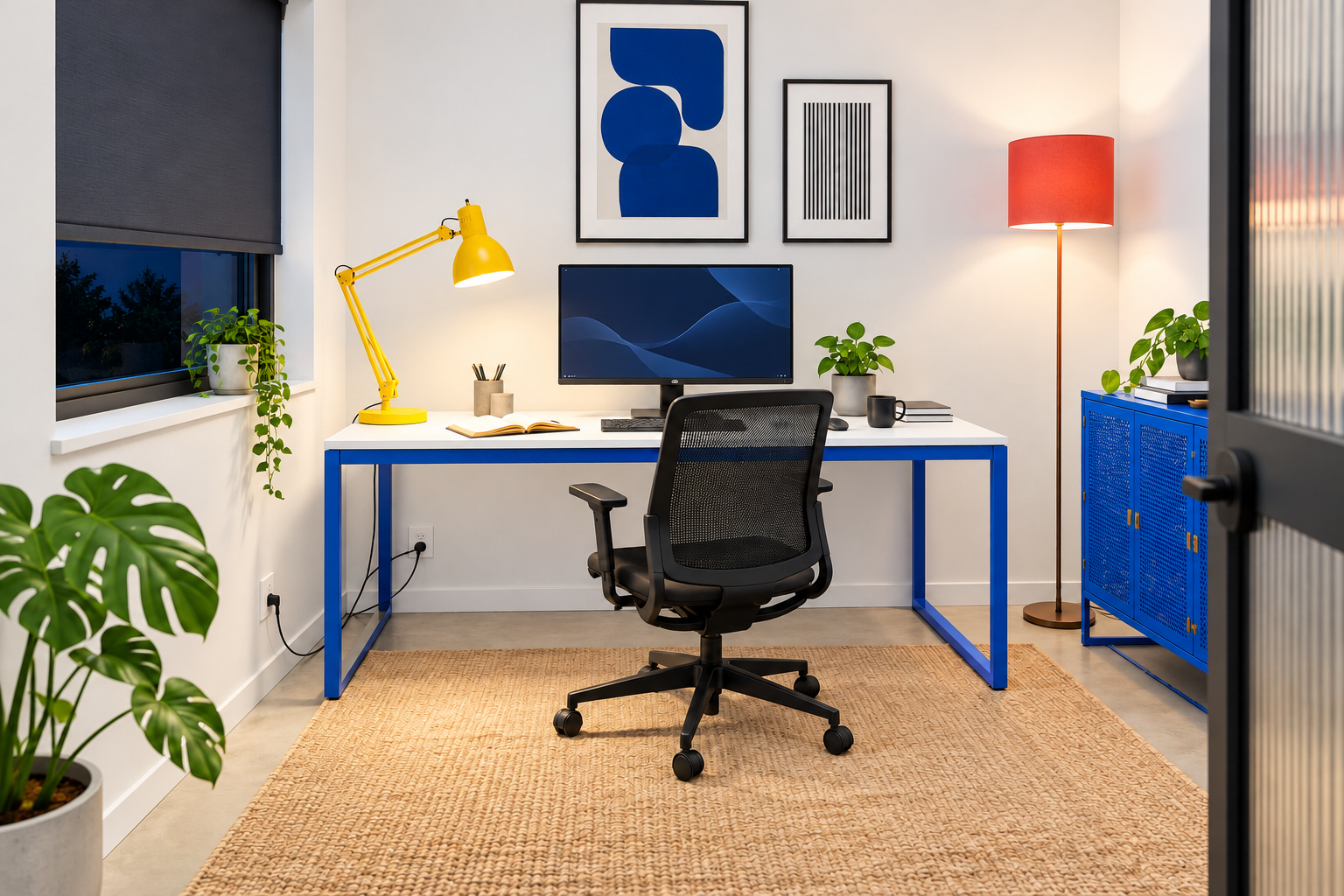
Image credit: pxef.com. AI-generated design concept.
The illustration gives this ordinary working corner a lively industrial palette. A white desktop rests on a cobalt steel frame, with a matching perforated-metal cabinet to the right. The yellow task lamp lights an open notebook on the left side, while a red shaded floor lamp adds light to the wall and surrounding room. The window is dark, making the evening condition clear, yet white surfaces and the chair remain visible in the ambient illumination. Blue graphic artwork and a ribbed glass detail add interest without requiring a crowded desktop. This is a generated lighting concept rather than a photograph of a measured installation; it shows the intended division of jobs between lights.
Our proposed room measures 3 by 3.4 metres, about 9.8 by 11.2 feet, with a 140 by 75 centimetre desk, roughly 55 by 30 inches. These are scene assumptions rather than measured dimensions of a built installation. More importantly, the illustration cannot establish light levels or prove the absence of glare. It explains a relationship: local light for the notebook, a separately illuminated room background and a screen that is allowed to remain readable without becoming the room’s only source of light.
Try the paper task first. Sit normally, open something you would actually read and put the lamp where it illuminates that page. Move your hand as if writing and notice where the shadow lands. The useful side depends on the task, the lamp and which hand you use. A position copied from a photograph may put your own hand directly between the light and the words. Adjust the lamp’s height and direction, then try the task again rather than judging the result from the doorway.
Keep the light source itself out of the way of your eyes. A shade or shield can help direct light toward the work, but check the result from your seated position. A lamp that looks elegantly angled from across the room may expose its bright bulb as soon as you sit down. Look at the monitor too. If the lamp appears in a dark part of the display, change its position or aim and repeat the check. You are looking for a useful working arrangement, not a single photogenic angle.
Then consider the room beyond the desk. Add a modest background light and compare the experience with the screen-only arrangement. The room should be visible enough to use comfortably, including the route away from the chair. In the concept, a second lamp lights the wall and surrounding area instead of adding another concentrated pool on the desktop. That lets the desk lamp do its specific job. The exact brightness and direction need trying in the actual room; wall finishes and furniture can change the effect substantially.
Controls should follow those different jobs. If you can switch the task light independently, it can stay off during a screen-only activity and come on for paperwork. A separately controlled room light gives another adjustment without forcing every surface into the same brightness. You may already have that flexibility with two ordinary lamps. A dimmer is useful only when the lamp, bulb and dimming control are compatible, so check their specifications before buying parts to work together. There is no need to make smart-home automation the price of having a readable notebook.
Color belongs in the design, but separate the color of the furniture from the appearance of the light. A yellow metal lamp can add energy even when its light is relatively neutral. A blue desk frame does not require a blue glow around the monitor. In this proposal, primary-colored furniture and crisp light surfaces supply the visual interest. That allows the lighting to serve work rather than act as a theatrical effect. Bright contemporary rooms can feel lively in the evening without becoming orange, purple or aggressively backlit.
When choosing a bulb or integrated fitting, examine more than the descriptive name. Lumens describe the source’s light output; they do not by themselves tell you how much light reaches the page in your arrangement. The shade, distance and direction matter. Color temperature describes the apparent warmth or coolness of the light, but it is not a complete account of how materials and colors will look. For tasks where color judgments matter, check the relevant equipment specifications and test with familiar materials. This concept is not a calibrated environment for color-critical work.
The monitor remains adjustable too. Once the lighting is reasonably placed, check the display with the applications you normally use. A bright white document and a dark editing interface can make the same room feel different. Use readable text sizes and display settings that suit the task rather than compensating for every problem by pushing brightness higher. If a reflection remains visible, identify the object producing it. Our window-glare guide explains that observation process; after dark, the window itself may also reflect the room.
A video call needs one additional trial. Open the actual camera application and look at your face and background together. A lamp aimed at paperwork may contribute little useful light to your face, while a bright fitting behind you can dominate the camera view. Adjust the call setup for the duration of the call if necessary. You do not have to preserve a webcam arrangement all evening when most of your work involves reading or typing. A repeatable small adjustment is often more practical than permanently arranging every lamp around the camera.
Finally, include shutdown and movement in the plan. Keep cables away from the chair’s wheels and walking routes, and make sure you can reach the room light without first crossing a dark area. In a shared bedroom or studio, consider where the light falls for someone who is no longer working. The bedroom office concept takes that transition a step further. A good evening setup lets you see the work, use the room and finish the day without leaving a miniature illuminated stage behind.