A Home Office That Works for Left Handed Tasks
Most desks are arranged by default for a right-handed person, often without anyone noticing that a choice was made. The lamp sits on the left, the pen pot and notebook on the right, the drawer unit on the right, the mouse on the right. For a left-handed person, some of those defaults work and some get in the way every day. The easy response is to mirror everything. The better one is to look at which tasks are actually done with which hand, because handedness is rarely as tidy as the word suggests.
Plenty of left-handed people write with their left hand and use a mouse with their right, because that is how they learned on shared computers. Others mouse left. Some cut with their right hand, throw with their left and play an instrument either way. A layout built on the assumption that a left-handed person does everything on the left will suit some people and annoy others. So this concept starts with one fictional person and their real tasks, and the invitation at the end is to test your own.
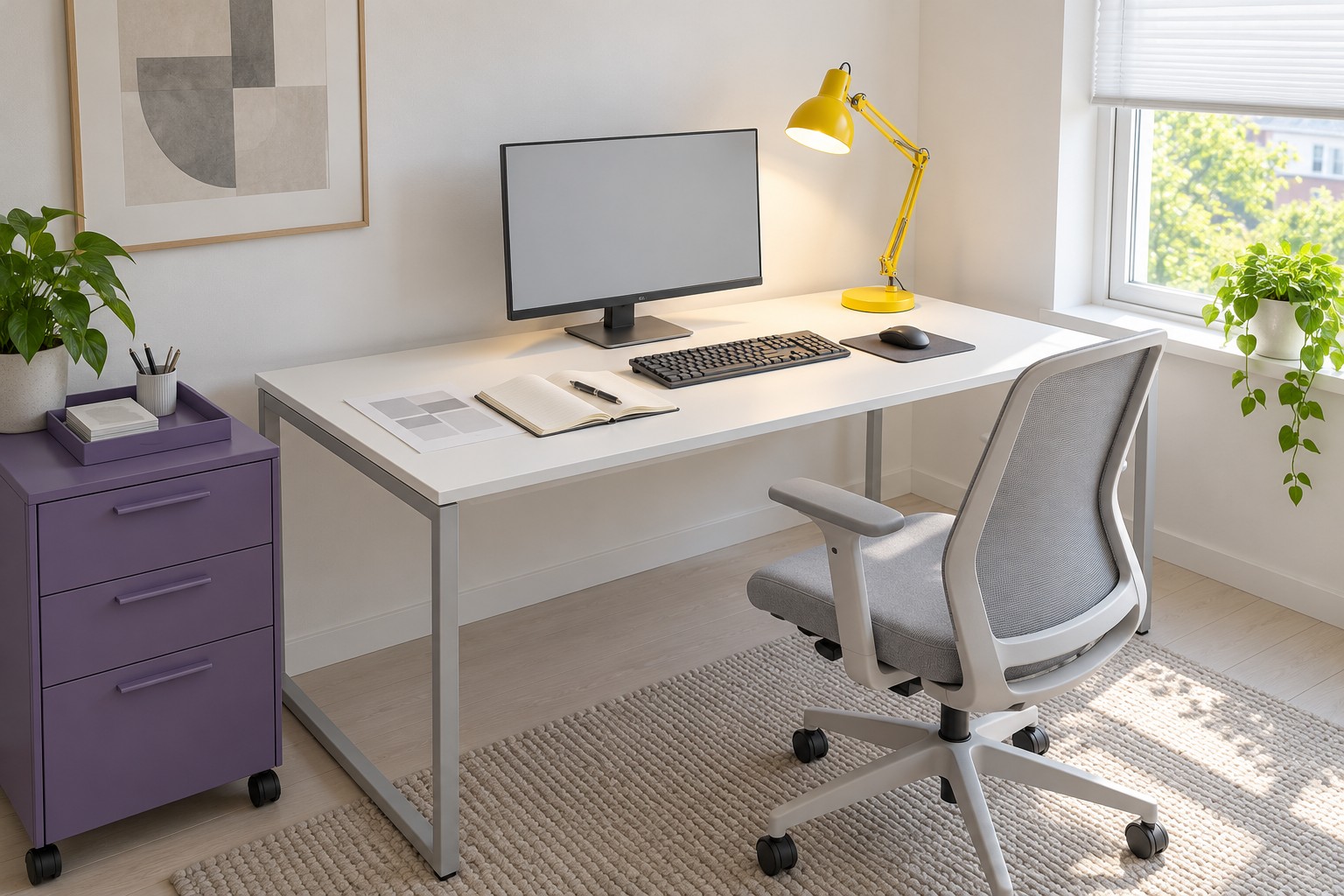
Image credit: pxef.com. AI-generated design concept.
The fictional user writes by hand with their left hand for much of the day, drafting and annotating printed pages, and uses the mouse with their right hand, which is simply their preference. The design assumes a room of 3 by 3.2 metres, about 9.8 by 10.5 feet, with the window on the right-hand wall, and a matte white desk of 140 by 75 centimetres, roughly 55 by 30 inches, against the far wall. A single monitor is centred on the keyboard. To the left of the keyboard there is a generous clear writing zone with an open notebook. A yellow task lamp stands on the right of the desk, and a purple metal drawer unit stands on the left, beside the writing zone. This is a proposed arrangement for one person, not a rule for all left-handed people.
In the image, the open notebook and single printed sheet occupy the left part of the white top, while the monitor and keyboard keep their central relationship. The mouse remains on its own dark pad to the right. Above it, the yellow articulated lamp aims across toward the writing zone. The purple drawer unit carries a small tray of pages and pens at the left, making the arrangement readable without a hand diagram or a special-purpose desk.
Begin with the writing zone, because it is the task this person does most with the left hand. A useful starting position puts the page to the left of the body’s centre line and angled the other way from a right-handed writer’s page, with the top of the page turned toward the right. School handwriting guidance describes exactly that position for left-handers and notes that many find a greater tilt helpful, while the right angle varies from person to person. On a 140 centimetre desk with the keyboard centred, roughly 45 centimetres of clear surface remains to its left, enough for an open notebook or an A4 page angled comfortably. The 75 centimetre depth lets the page sit low enough to write on without the keyboard in the way.
Light comes next, because a lamp in the wrong place puts your own hand’s shadow across the line you are writing. Lighting researchers recommend placing a task light on the side opposite the writing hand and slightly forward, which for this person means the right. The yellow lamp in this concept stands on the right side of the desk, angled down toward the notebook on the left, so the light falls across the page from the right and the left hand’s shadow falls away from the pen. The window on the right-hand wall does the same during the day. If your room’s window is on the left, a lamp on the right becomes more important, especially in the afternoon.
Supplies belong on the writing side. Pens, a pencil, sticky notes, the current printouts and a ruler are reached by the hand that uses them. Here the purple drawer unit sits on the left, its top tray holding pens and today’s papers within reach of the writing hand. A right-handed layout often puts all of that on the right, which forces a left-handed writer to reach across the body and across the keyboard dozens of times a day. Moving the supplies costs nothing.
The screen and input devices are adjusted independently of the writing setup. The monitor stays centred on the keyboard, because the keyboard is used with both hands and the screen should be straight in front for typing. The mouse sits on the right, because that is this person’s choice. If you mouse with your left hand, try it on the left and check reach from your actual typing position. A right-side number pad mainly lengthens the reach to a right-side mouse; it does not create the same obstacle on the left. A compact keyboard can still help you arrange the typing keys, notebook and mouse together. Most operating systems also let you swap the primary and secondary mouse buttons if that feels more natural. None of these depends on how you write.
Page orientation and smudging are small daily frustrations worth solving. A left-handed writer moving across the line from left to right can drag the hand over fresh ink. Quick-drying ink, a suitable pencil or a different page angle may help, and different people settle on different combinations. Notebook bindings can get in the way too, depending on which page you write on and how the book opens. Rather than following a rule, try a few notebooks and see whether the spine or rings sit under your hand.
The temptation to mirror an entire room is worth resisting. Flipping a picture of a right-handed office produces a lamp on the right, which helps the writing, but it also moves the mouse, the drawer and the chair’s approach, and some of those may suit you exactly as they were. It can put the window in the wrong place for the screen. Universal design means making it easy to adapt each element to the person, not reversing everything for a category of people.
Some tasks are worth checking specifically. If you cut paper with scissors, notice which hand you use and whether right-handed scissors work for you; left-handed scissors exist and some people find them much easier. If you use a craft knife, the ruler and the cutting direction may want a particular side. If you use a drawing tablet, its position relative to the keyboard follows the drawing hand, which may not be the mouse hand. Each of these is an individual decision, made by watching what you actually do.
The concept’s colours keep the arrangement readable. A purple drawer unit marks the writing side, a yellow lamp marks the light source on the opposite side and the matte white desk between them keeps the surface calm. It is a bright, simple scheme that makes the logic of the layout visible at a glance, which helps when you are explaining to someone else in the household why the lamp is on that side.
A short test does more than any rule. For one day, note each time you reach for something, which hand you use and whether it means crossing your body or the keyboard. Write a page with the lamp on the left, then on the right, and look at the shadow. Try the mouse on each side for half an hour if you are unsure. Then arrange the desk around what you found. If you share the desk with a right-handed person, the parts that differ, mainly the lamp and supplies, can usually move in a few seconds; our guide to a home office for reading and writing shows the same principles for a right-handed writer.