What Soft Furnishings Can Change in a Noisy Home Office
A home office can be noisy in two quite different ways, and most of the frustration with rugs and curtains comes from mixing them up. One is a room that sounds hard: your voice rings slightly on calls, the keyboard clatters, a chair scraping the floor seems louder than it should. The other is noise arriving from somewhere else: a television through the wall, a conversation in the next room, traffic outside, footsteps from the flat above. Soft furnishings can help with the first. They do very little for the second.
The distinction is between sound inside the room and sound passing into it. Inside a room, sound bounces between hard surfaces before it dies away. The longer that takes, the more echoey and lively the room sounds; acousticians call it reverberation. Soft, porous materials absorb some of that energy and shorten the tail. Sound arriving from another room is a different matter. It travels through walls, floors, doors and gaps, and stopping it depends mostly on the mass and airtightness of the construction between you and the source. A rug cannot add mass to a party wall, and a curtain cannot seal the gap under a door.
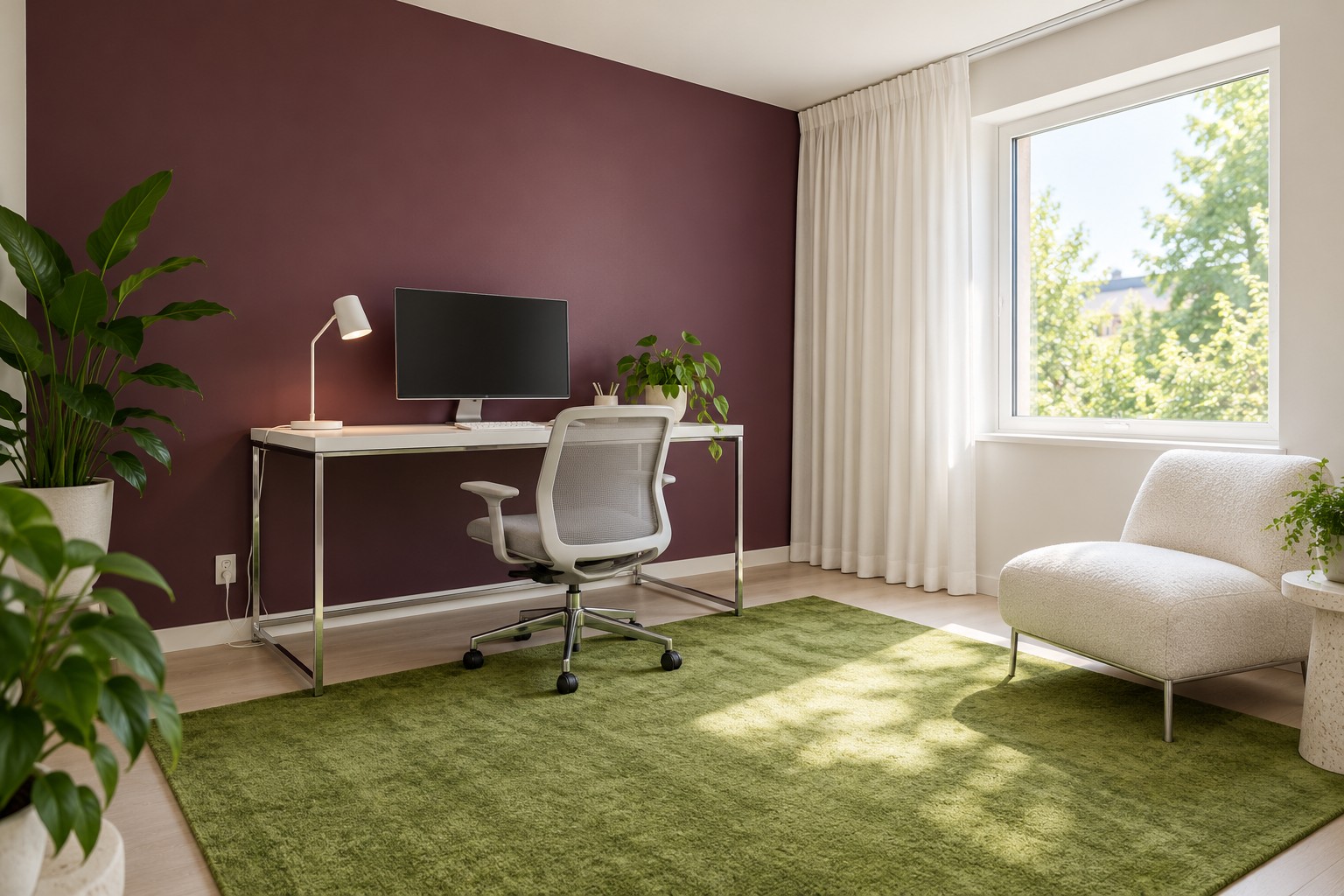
Image credit: pxef.com. AI-generated design concept.
This proposal shows an ordinary room furnished with that difference in mind. The design assumes a room of 3.2 by 3.6 metres, about 10.5 by 11.8 feet, with a hard floor, white walls and one plum-painted wall. A metal-framed desk stands against the plum wall. A large green rug covers much of the floor between the desk and the door. A full-length, substantial curtain hangs at the window on a track that keeps it clear of the desk and its cables. A small upholstered seat in the corner gives a second place to sit. It is one honest furnished room, not a measured acoustic treatment, and nothing in it is presented as rated or certified.
The chrome desk frame stays visually thin against the plum wall, and the white mesh chair sits partly over the green rug. At the right, the textured armless seat repeats the curtain’s pale colour without turning the room into a padded study. Sunlight crosses the rug in a broad patch, which is also a reminder that the curtain’s daytime position affects the working light.
Start with what these pieces can plausibly do. A rug on a hard floor can reduce some noise generated at that surface, such as footsteps or a chair moving; its effect depends on the rug and the floor. Published guidance on classroom acoustics makes a similar point about carpet, noting that it mainly reduces this kind of self-generated noise and adds some absorption at higher frequencies, while carpet alone does not dramatically change a room’s overall reverberation. So expect a rug to make the room feel quieter underfoot and a little less bright in tone. Do not expect it to stop the neighbours’ music.
A heavy curtain adds a large area of soft, porous material on a surface that would otherwise be glass, one of the most reflective materials in the room. Drawn, it absorbs some of the sound that would otherwise bounce off the window. That can soften the room’s acoustic, particularly for voices. How much depends on the fabric’s weight and weave, how much of it there is, whether it hangs in folds and how far from the glass it sits. A thin decorative curtain will do much less than a heavy, generously gathered one.
Upholstered furniture contributes too. A fabric seat, a padded chair and soft cushions add more absorbent surface. Books of different depths can make a wall less uniformly reflective, but an ordinary bookcase is not a calibrated sound diffuser. Each element on its own is modest. Together, in a small room with hard floors and bare walls, they can make an audible difference to how echoey it sounds.
Now the limits. Soft materials tend to be more effective at absorbing higher-frequency sound than low. The same classroom guidance describes carpet as generally poor at absorbing low frequencies. Low rumbles, deep bass from a neighbour’s speaker, traffic hum and the thump of footsteps from above are largely untouched by a rug or a curtain. Speech sits partly in between, which is why soft furnishings can make your own voice sound less boomy on a call without making the room any more private.
Privacy and isolation belong to the building, not the furniture. Sound passes through the weakest part of a wall or partition, and acoustics guidance is blunt that windows, doors, small gaps and cracks can undo an otherwise good wall. A hollow door with a large gap underneath is a common leak. A curtain over a door changes how the door looks; it does very little to what passes through. If you need confidential calls, the useful questions are which room has a solid door that closes properly, which shares the fewest walls with noisy rooms and what times the household is quiet. Our article on two people working in one room covers the scheduling side.
Decorative wall panels deserve particular caution. Felt tiles, slatted timber and fabric shapes are sold in large numbers, and some are made from genuinely absorbent material with published test data. Many are not. A panel’s appearance tells you nothing about its performance, and even a properly tested absorber only affects reverberation within the room. If you are considering acoustic products, look for manufacturer test data from a recognised method rather than words like “acoustic” or “soundproof” in a product name, and still treat them as reverberation treatment, not isolation.
The concept keeps the curtain clear of equipment for practical reasons. A full-length curtain near a desk can snag a chair, drape over a power strip or block a radiator or vent. Here the drawn-back white fabric stacks beside the window with a clear gap from the desk, while the cable drops at the desk’s opposite end. A heavy curtain also changes the light; drawn across the window during the day, it will darken the room. That is a real trade-off in an office. Try it drawn for a call only if useful light remains on the desk and your face.
You can test changes in your own room without any instruments. Before adding anything, record a short clip of yourself speaking at your desk with your phone or call software, in a normal voice, with the phone in a fixed position. Clap once sharply and listen to how long the sound hangs. Roll the chair across the floor and note how it sounds. Then add one change, say the rug, and repeat exactly the same tests with the same phone in the same place. Listen to the recordings one after the other. If a colleague says you sound hollow on calls, ask them to comment before and after too. This is a comparison, not a measurement, but it tells you whether a particular change is worth keeping.
Some problems will not respond, and recognising them early saves money. If the noise comes from outside the room, if it is mostly low-pitched, or if what bothers you is being overheard, soft furnishings are the wrong tool. Better options might be a different room, a door that closes properly, a headset with a microphone that picks up mainly your voice, or simply agreeing quiet hours. Building work to improve sound isolation is a specialist job and depends on the construction; it is outside what a furnished concept like this can promise.
What is left is a pleasant, achievable improvement. In the concept room, the green rug makes the floor quieter and gives the space its strongest colour. The plum wall and white surfaces keep it bright. The curtain softens the window when drawn and frames it when open. The upholstered seat gives a reason to leave the desk now and then. These additions may reduce some room reflections compared with bare floors and glass; the illustration cannot establish the result. It will not be soundproof, and nobody should claim that it is.